nuncheon: (mesopotamia)
While I was away from this blog, I cooked the Tuh'u Beet Broth twice for other people; once at a potluck and once at a camping event; both went well, though I will have to try it with a different root vegetable than beetroot at some point.

I've also read a book on cuneiform writing ("Cuneiform", by Irving Finkel and Jonathan Taylor), watched a good handful of videos of lectures by Irving Finkel who is an utter delight to listen to, read up on Mesopotamian mythology, and took an Open University free course on Babylonian mathematics, because why not. There are also a lot of intriguing youtube videos. I'm certainly not the only one trying ancient Mesopotamian cuisine!

There are things I didn't know before I read "The Oldest Cuisine in the World". Meat was cooked ("prepare water; add fat"); roasted meat was reserved for the gods as the older way of preparing meat. Pepper doesn't seem to have been known in the area at the time the tablets were written - although of course those tablets only give a brief glimpse into the cookery of Mesopotamia. If I really wanted to go down that particular branch of food and cooking history, I would start researching indirect sources, ie other translated cuneiform tablets and other writings to find mentions of food / dishes, including religion (the Old Testament comes to mind) and mythology.

I didn't realise how old the tannur is, the clay oven where bread was baked on the hot inside, like a tandoor, or clay ovens of very similar names all over the region.

I love that the wild man Enkidu in the Gilgamesh stories is tamed not only through sex with a Temple prostitute, but also by eating bread and drinking beer - and lots of both, in fact. Processed food divides human from animal.

There is also the Hymn to Ninkasi, Goddess of Beer, which is an instruction for brewing beer, and it would be interesting to follow those instructions.

There are still recipes in "The Oldest Cuisine in the World" which I want to try, especially the one that reads like a chicken pie, one of the pigeon dishes with mint and vinegar, and one of the porridges cooked with beer that were served with cooked birds, together with thin buttermilk breads and honey. But for now, I'm putting this one aside.


For Ningirsu, the champion of Enlil,
Entemena, the Prince of Lagash,
The elect of the heart of Nanse,
The son of Eanatum,
Had this pitcher of pure silver made,
So that Ningirsu could enjoy his butter in it."

(dedication on a silver vessel by Entemena, king of Lagash, ca 2400 BCE. This Silver Vase of Entemena is now in the Louvre. As for any translation of writings from that time, YMMV.)
nuncheon: (mesopotamia)
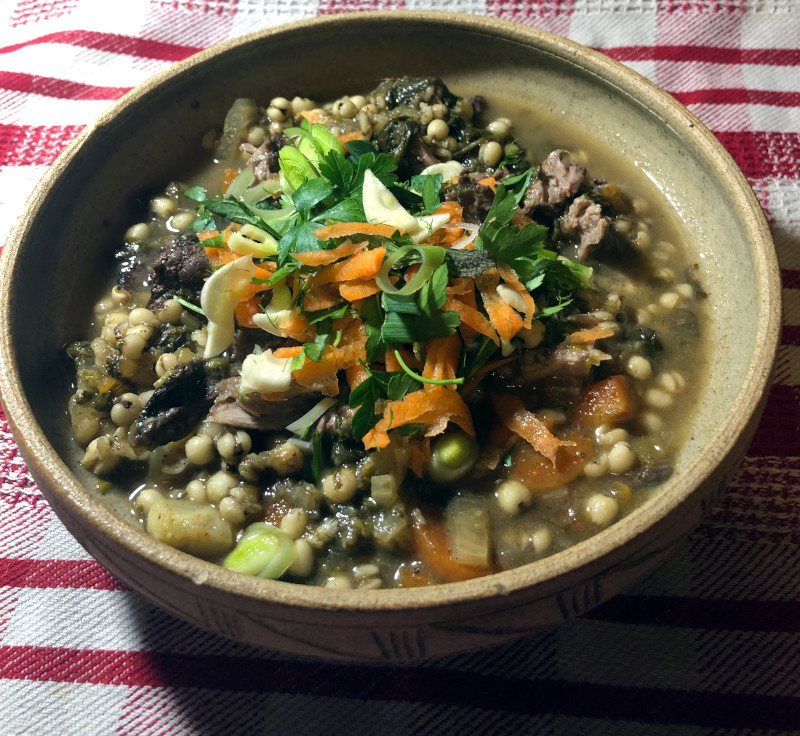
This is going to be very variant, as the meat I'd taken from the freezer earlier didn't turn out to be mutton, but half a rabbit (sans legs, but with offal - such as the liver, which I had already snaffled pan-fried, yum; anyway). So in the spirit of "meat is used", and seeing as rabbits / hares were known in Mesopotamia, it will be the variant of the Kanasu broth recipe.

Kanasu broth. Leg of mutton is used. Prepare water; add fat, samidu, coriander, cumin, and kanasu. Assemble all the ingredients in the cooking vessel, and sprinkle with crushed garlic. Then blend into the pot suhutinnu and mint.


Take a piece of carrot and grate it and keep some of the sliced leek back; add to that finely sliced garlic and mint. This will be topping the dish at the end.
Another variant is that I used an onion, finely diced, sweated off in fat. Add diced garlic. Add meat, brown; season with coriander, cumin, and salt. Add finely diced carrot and leek, let heat a little. Add water and let the whole thing simmer until the meat is almost done. Add a handful or two of pearl barley (or wheatberries / freekeh if available). Cook until the grains are soft, adding water if needed.

Serve topped with the fresh vegetables.


I think I prefer this version to the one with the roux; the grains cooked in the stew give it a little more bite.
Suhutinnu is one of those words where meaning is unsure; is it an allium or a root vegetable? So I used both the grated carrot and sliced leek at the end together with the the mint and the fresh garlic which gives heat. The raw vegetables at the end give the whole dish some added freshness. In case you're wondering, yes, that is also some parsley.

I can see this becoming one of my staple dishes.
nuncheon: (mesopotamia)
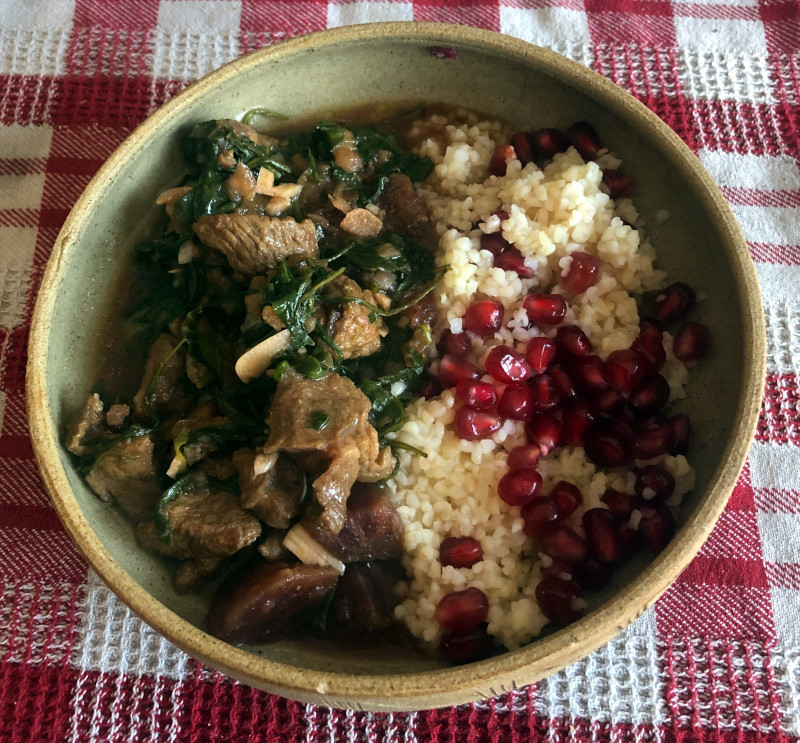
Tuh'u Beet Broth. Lamb meat is used. Prepare water; add fat. Peel the vegetables. Add salt; beer; onion; arugula; coriander, samidu, cumin, and the beets. Assemble all the ingredients in a cooking vessel and add mashed leeks and garlic. Sprinkle the cooked mixture with coriander, and suhutinnu.

It appears that "tuh'u" may not be beets but wheatberries.
It also appears that there are two translations, one that says "meat is used", and one "meat is not used", so it may be a vegetable dish, or a kind of porridge cooked with beer and greens. Perhaps in time when more of the cuneiform tablets are translated, these things may become more certain, but unless someone invents a time machine, we just can't be sure what the actual dish was.

For this, I have followed Bottéro's translation above, together with a suggestion found online as to what kind of beer could be used, which was a German Weissbier. As to what tuh'u beets would be, if indeed they are beets, is unknown. I had beetroot, so I used that.

Finely dice onion, sweat them off in fat (I used a mix of ghee and olive oil). Dice as much garlic as you'd like, add to the onions; once they are getting soft, add the diced lamb. Brown the meat and season with salt, cumin, and ground coriander. Put in the diced beets and cover with the beer. Let simmer until the meat is soft and the broth has the desired taste. Add the arugula and leek and cilantro (if used). Let the greens wilt slightly and add some finely sliced fresh garlic.

I served it with bulgur and pomegranate seeds.


nuncheon: (modern snail)
The following is not a try at recreating an authentic Mesopotamian dish; it is a modern dish inspired by the recipes of the Yale tablets.

Halazzu in broth. Meat is used. Prepare water; add fat; salt, to taste; onion, samidu, leek and garlic, mashed with kisimmmu. Crush some of the cultivated plant called halazzu. Assemble all ingredients in a pot.

Halazzu, according to Laura Kelley, is Carob. Kisimmu is either a sour milk product or fresh cheese.


The Recipe

Ingredients:
diced meat (I had turkey steaks which, while definitely not period, worked well)
dairy (I had Turkish cheese; sour cream or yoghurt are alternatives)
1-2 onion, finely diced
3 cloves of garlic, finely diced (or as much as you would like, really)
2-3 cloves of garlic, finely sliced (to go in at the end)
1 small fennel, diced (for that aniseedy flavour)
1 leek, sliced
1 head of bok choi, sliced (told you it was inspired by)
1-2 carob pods, either diced or ground
1-2 teaspoons of grape molasses
a pinch or two of ground coriander
a dash of white wine vinegar or cider vinegar
salt to taste

Brown the onions and diced garlic until almost done; add the meat and brown. Add the fennel. Season with salt and coriander. Add the carob and grape molasses; add water and cook / simmer until the meat is almost done. Taste the broth and add vinegar, salt and coriander to taste. Add the leek and bok choi, add a little water if needed, simmer.
When the meat is done and the broth has the desired taste, add the finely sliced fresh garlic and the cheese / sour cream.

Serve with bulgur.

The carob in the broth has an almost chocolatey flavour. I used the grape molasses for added sweetness. The vinegar and cheese bring acidity, while the garlic at the end gives a little heat.

Not authentic, no - but quite tasty, if I do say so myself.

nuncheon: (mesopotamia)


Mutton is definitely the right meat to use, because the flavour it gives to the broth is fantastic. If no mutton is available, lamb should be ok. The dish works very well flavour-wise - coriander, cumin, and garlic are a classic combination for a reason. The mint brings freshness to the dish, while the carrots bring the sweetness. The leeks have almost completely cooked away.

The thing I'm not sure about with this version is the mouthfeel - because it's been cooked on a roux-base, it has turned a little slimy, and it sits rather heavy in the stomach.

So the other version I am planning, while still using mutton, will feature turnips if I can get them, beets otherwise, fresh mint, and grains boiled in the broth. If I can't find wheatberries or freekeh, I will probably use bulgur.
nuncheon: (mesopotamia)
Kanasu broth. Leg of mutton is used. Prepare water; add fat, samidu, coriander, cumin, and kanasu. Assemble all the ingredients in the cooking vessel, and sprinkle with crushed garlic. Then blend into the pot suhutinnu and mint.

"Kanasu" is variously translated as Emmer, Spelt, or Wheatberries. So, either a flour or the grains cooked in the stew.
"Samidu" I will still treat as semolina, because apart from one translation where they say it's an onion, everyone (both because of linguistics and from a cooking point of view) uses semolina.
"Suhutinnu" is most likely a root vegetable (or maybe a leek, as one translation says). Other tablets refer to it being "dug up", and it has been variously approximated with beets, turnips, or carrots. In other recipes Suhutinnu is used raw at the end of the cooking process.

I am going to make two variations of this dish. For the first one, I will use mutton, olive oil, two tablespoons of strong bread flour (because for some reason I had neither spelt nor emmer flour; NB I never use self-raising flour), a tablespoon of semolina, ground coriander and cumin, carrots and leeks, garlic, and mint. I'll also add salt, both for modern tastes and because I am rather sure that, although salt is mentioned only once or twice on the tablets themselves, it would have been added to the dishes.

Sear off the meat in the olive oil; take out. To the oil, add a mix of the flour, semolina, and spices; add a bit of water to thin the resulting roux, cook out the flour. Add the thinly sliced garlic; add mint if dry is used - fresh later. Add sliced carrots and leeks and the meat, add enough water to cover it. Cook until everything has the desired softness. Season to taste.

At the moment it is still cooking away and smelling rather yummy. I will post a picture once it's done.
nuncheon: (cook and kettle)
It was in the late 1980s that medieval fairs became a fast-growing thing in Germany. They might be compared to renfairs, only more medieval(-ish) and without the fantasy elements. They had music (such as Corvus Corax), fight shows, general entertainment for children and grown-ups, artisans showing off their art, booths selling food, drink, and various medieval accoutrements.
Next to the main fair, there was always a historic encampment where people lived in tents for the weekend, wearing medieval (or Viking, or even Roman) clothes and cooking in pots on open fires, living past lives for a long weekend. These areas were roped off so that none of the fairgoers could mill about or look into people's tents. I can vividly remember standing at those ropes gazing at the encampments with a wistful look, hoping that someone would come and talk to me and tell me how to join these amazing things.

Fast forward a couple of decades, and last year I found myself wearing medieval clothes, cooking in a pot on an open fire, my tent behind me, and modern people watching with a wistful look, and on that realisation I had quite a moment.

Anyway. Back in the late 1980s and probably at one of those medieval fairs I acquired my first "medieval" cookbook, called "Wie man eyn teutsches Mannsbild bei Kräften hält" (roughly "How to keep up a German fellow's strength"), which had medieval recipes for modern cooks. From today's point of view, while it's certainly an interesting first look, it doesn't even have a bibliography or lists the provenance of recipes beyond "this was enjoyed by Sabina Welserin" or "as the monks of Tegernsee made it". Back then I was fascinated, and on one memorable occasion invited a handful of good friends for a "medieval feast", where I/we cooked recipes from that book and ate it by candlelight while we played medieval music on a portable CD player. The invitation was hand-written and probably doesn't survive any more.

Again, fast forward a few decades and a move from Germany to the UK. The year is 2014, and I am visiting Loncon, the World Science Fiction Convention in London, where I happened upon a stall set up by the SCA, with people in medieval clothes doing medieval things and explaining them to people. The wistful look was back, only this time there was a piece of paper where you could write down your email address and location and someone would contact you. I did, and they did, and two months later I was at my first Revel.

There was a potluck.

A few years later, my local branch of the SCA held a weekend event which had a feast on Saturday. I was so nervous before that event, which was after all my first big event, that I spent some time before that in my own kitchen making little marzipan dragons. On the Saturday I was in one of the three kitchens, kneading dough and baking bread which was served at that feast.

From then on, hooks were firmly attached and dragging me into the rabbit hole. Once I realised my early mistake of looking at things I like and finding medieval recipes for those dishes or approximations thereof (something probably born from my experience in cooking and inexperience in medieval recipes) and instead started looking at medieval recipes and finding what I like, there was no going back.

Now, a handful of feasts and open-fire cooking experiences later, I am starting to get a feel for medieval recipes and actually incorporating them into my daily cooking. I have also acquired an as yet uncounted number of recipe books - which is where this blog comes in. So, in the next post I will go back to the Mesopotamian cookbook!

Addendum: I have some pictures in relation to my SCA cooking and might do a photo dump entry later which might amuse.
nuncheon: (mesopotamia)
From Tablet A of Old Babylonian culinary recipes:
Salted Broth
Leg of mutton, but no other meat is used. Prepare water; add fat; wild liquorice as desired; salt to taste; juniper; onion; semolina; cumin; coriander; leek and garlic, mashed with kisimmu. It is ready to serve.

"Kisimmu" is variously translated as fresh cheese, sour milk, or yoghurt. As an aside, especially with texts this old (and probably with younger texts as well), you can't rely on one translation, something which I noticed when I tried to find out what Bottéro meant with an ingredient he translated as "cypress". Turns out it's more likely juniper, which makes a lot more sense. Mashed leek and garlic appears in every recipe I've read so far and seems to be a staple seasoning.

Ingredients and substitutions - Now that's not very authentic is it

No, but I was hungry and used what I had. Mutton became beef. Wild liquorice became aniseed as it has a similar flavour profile. Coriander was the powdered version where fresh was probably used. I sweated off the onion with the aniseed and juniper before adding the meat, frying that off before adding water. My fat was ghee. I used one leek which I cooked in the broth, and mashed spring onions and garlic with the only soft cheese I could get which was mozzarella (I know - I'll have to visit the local Turkish shop to see if I can get some kishk or similar). Put some semolina in to bind, then added the mashed spring onion-garlic-cheese mix.

The result is a very flavourful and unusual broth / stew. The aniseed, spring onions and cheese gave it a pleasant freshness, while the garlic gives heat (didn't even miss pepper, and I love pepper). Beef worked well, but I can see mutton giving more meaty flavour, and it would also lend itself to longer cooking. Sour milk cheese or yoghurt would definitely be better than mozzarella as the stew could use some sourness.


I'm going to try and source ingredients more "authentic" than the ones I used here, but for a first taste of a dish inspired by Mesopotamian recipes, not bad at all.
nuncheon: (Default)
My son, let me give you instructions, may you take my instructions!

Why not start my journey through historic cooking at the very beginning, in what is arguably the first civilisation's food and drink. In the Yale Babylonian Collection are three cuneiform tablets dating from around 1600 BCE which contain about 40 recipes.

Imagine - someone wrote these down almost 4000 years ago. It's staggering.

Assyrologist Jean Bottéro's book "The Oldest Cuisine in the World" first sets the scene, giving a brief introduction on the history of the region and peoples of Mesopotamia. Secondary and primary sources follow. There are chapters on food preparation and equipment, drinks, and court and religious life as relates to food, all of it fascinating.

I'm currently only on page 27, where the primary sources are listed, and I already want to try two recipes. There is a meat broth/stew with asafoetida, watercress, wild liquorice, cumin, and cucumber which sounds intriguing.


A post about Mesopotamian cuisine would not be complete without giving a link to an invaluable website: Some Mesopotamian Ingredients Revealed by Laura Kelley. Where Bottéro is not sure about a translation, Kelley supplies through research and knowledge of current foods of the region.

A thought on ingredients. Onions, leeks, garlic etc. These are obviously not today's varieties; will they give a similar taste nonetheless? Even meats will be different. If a recipe calls for wild liquorice, is a substitution of today's liquorice and / or aniseed allowed? I will cook and find out as much as I can.
nuncheon: (Default)
This blog is all about historical cooking and eating, and more importantly cooking from medieval cookbooks and trying to recreate dishes that were eaten hundreds of years ago. "Medieval" is a loose term - anything pre-17th century goes for this venture into experimental archaeology.

I'm a member of the Society for Creative Anachronism residing in the Kingdom of Drachenwald (principality of Insulae Draconis). I have cooked on open fire during camping events and (with assistance from awesome kitchen crews) feasts for up to 70 people in kitchens of varying excellence. During my fall down this particular rabbit hole acquired n+1 cookbooks. So this is me going through them and having fun in my own kitchen.

There will be lists of books, recipes, experiments, pictures of the results, and redactions for those who want to cook along and have a taste of what our ancestors ate.

Profile

nuncheon: (Default)
nuncheon

What's this?

This blog is all about historical cooking and eating, and more importantly cooking from medieval cookbooks and trying to recreate dishes that were eaten hundreds of years ago. "Medieval" is a loose term - anything pre-17th century goes for this venture into experimental archaeology.

July 2022

M T W T F S S
    123
45678 910
11121314151617
18192021222324
25262728293031

Most Popular Tags

Style Credit

Page generated Feb. 4th, 2026 03:55 am
Powered by Dreamwidth Studios